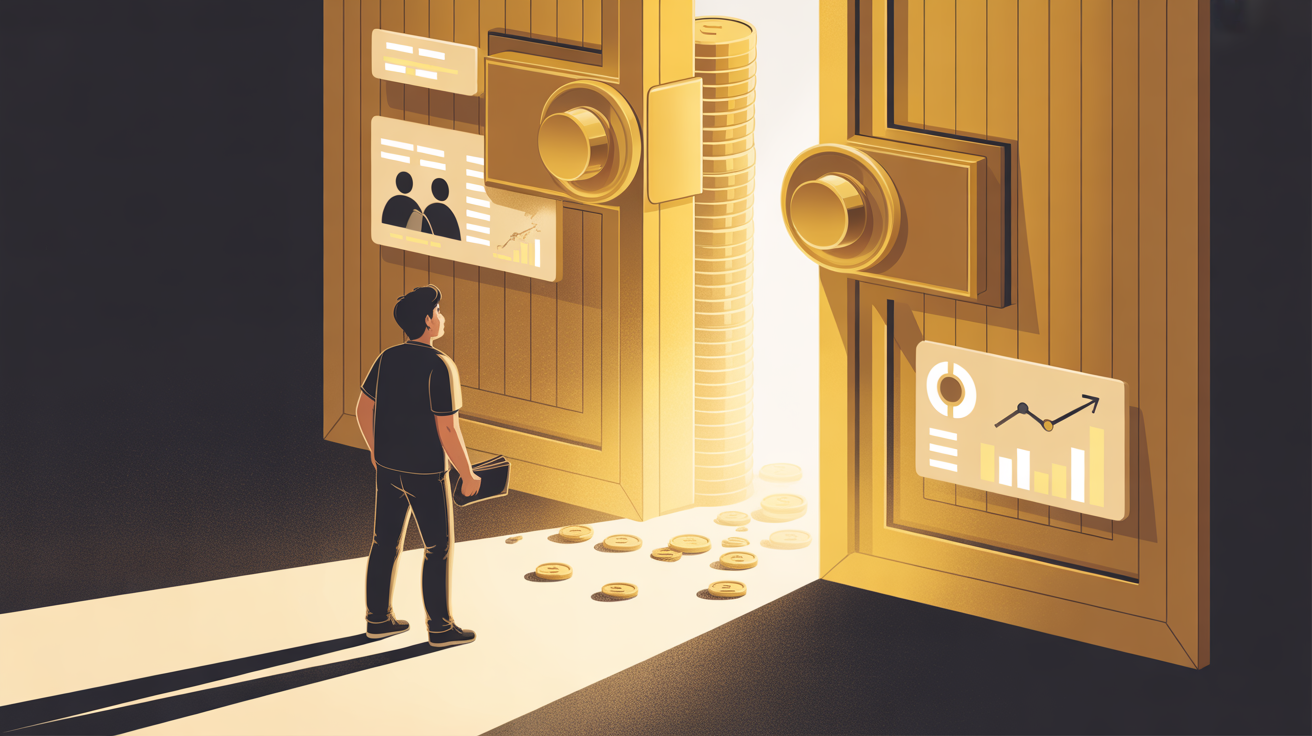
The gap is real. The $270K hiring line locks small studios out. Buying the capability closes the gap without the hire.
The gap is real.
The $270K hiring line locks small studios out.
Buying the capability closes the gap without the hire.
This is not a feature story. It is a budget story with revenue consequences.
Most indie studios do not fail to personalize because they lack good instincts. They fail because the job description crosses a cost line they cannot justify yet. Personalized monetization is not one toggle. It is a stack of labor, judgment, and iteration. That stack adds up quickly.
If the team cannot carry the work, the studio does not get the outcome. That gap is the distance between a studio with 1K to 10K DAU and the kind of monetization team that can keep segmentation, offer timing, and live tuning running at the same time.
How much does a game monetization team actually cost?
Start with the number, because the number is the gate.
The $270K figure I use is an internal loaded-cost model, not a vanity estimate.
A serious personalized monetization setup usually needs more than a tool buyer. It needs someone who can read player behavior, design the offer logic, and keep the economy stable while the shop changes around it. That means a senior data scientist and a strong economy or product designer, plus employer load, benefits, and the real cost of keeping both people in one market.
I built the $270K model from published compensation bands for EU and NA markets, then loaded it with the normal employer costs that small studios still pay in real life. The exact mix varies by city and seniority, but the conclusion does not. For a small studio, this is not a minor line item. It is a commitment that changes the hiring plan.
If personalization were a light implementation task, the cost would sit closer to tooling. Instead, it sits closer to headcount. That is why the debate is not whether personalization matters. The debate is whether the studio can afford the team that makes personalization work every week.
What that team actually does
The team is not there to generate buzz. It is there to keep the system learning.
Personalized monetization is a coordination problem before it is a software problem.
The work is concrete. One person reads player behavior and maps it to offer logic. Another keeps the economy legible so the offer fits the moment. The team watches progression stage, spend intent, friction points, return behavior, and timing.
This is where the 20-30% uplift matters. That range is the reason studios care in the first place. When the offer matches the player state, the lift is not subtle. It shows up in conversion, attach rate, and average revenue per paying user. The system is doing exactly what the player was waiting for.
The team is only expensive if the studio has to own the whole loop itself.
Why most indie studios cannot afford it
Most studios do not object to the theory. They object to the payroll.
The gap exists because the team is too expensive for the revenue base, not because the thesis is weak.
A studio with 1K DAU, or even 5K DAU, can understand the upside. What it cannot do easily is justify a permanent two-person specialist layer before it has the revenue depth to absorb it.
This is why the hiring line locks small studios out. It is not a judgment on quality. It is an arithmetic problem. The studio may have a strong game, a healthy community, and decent retention. None of that changes the fact that a $270K annual commitment is large relative to the monetization pool in early scale.
Once the studio sees the cost clearly, the next move becomes obvious. The studio either delays personalization until it can afford the team, or it looks for a way to capture the same function without carrying the full headcount. The second path is where buying the capability starts to matter.
What small studios do instead, and why it leaks revenue
When studios cannot hire the team, they default to static offers and hope the market absorbs the waste.
The fallback is usually simple, and simple is expensive here.
Small studios usually do three things. They ship one starter pack to everyone. They reuse the same promotion cadence across all players. They let the shop speak in one voice because it is easier to maintain.
The problem is that the player who just hit a wall does not need the same offer as the player who is browsing for status. The day-one player is not the same as the returning payer. The returning non-payer behaves nothing like the player who is one session away from a first purchase. Static offers treat all of them as one.
The leak is not always visible in dashboards. It shows up as lower conversion, weaker attach, and fewer players reaching the right price point at the right time. That is why 20-30% uplift matters so much. The upside is not coming from more traffic. It comes from turning more of the traffic you already have into relevant buyers.
The next problem is not mechanics. It is attention.
The bandwidth problem dressed up as a tech problem
The real blocker is usually bandwidth, not architecture.
Studios say they need a platform. What they usually need first is time.
This problem gets mislabeled as a technology issue because tech feels solvable. In reality, the hard part is the weekly loop. Someone has to interpret the signals, someone has to decide the offer, someone has to review the outcome, and someone has to keep the economy from drifting. That is bandwidth.
A small team can own analytics. It can even own experiment design. What it cannot own indefinitely is a high-touch personalization workflow on top of everything else.
Better inputs beat a bigger team.
That is why the conversation breaks at the wrong point. Studios compare tools and miss the labor.
What buying the capability actually delivers
Buying the capability is not a shortcut. It is a way to acquire the missing labor without hiring the full team.
The value of the buy path is not only code. It is compressed execution.
A real buy path should shorten the distance from signal to offer, reduce the internal decisions required to launch, and keep the learning loop alive without a specialist department. That is the point of the Qyren numbers: 20-30% revenue uplift, 7 days to integrate, and 5 lines of SDK code.
If the integration is fast, the code is light, and the player base is above the 1K DAU floor, the studio can start without rebuilding itself first.
The internal target I use for offer-to-signal matching is 87.5%. Below that, uplift compounds slowly because too many offers land against the wrong state. At or above that bar, every triggered offer becomes a meaningful contribution to lift. Whatever path a studio chooses, the bar exists. Without it, the team is shipping triggered offers without knowing whether they are actually relevant.
Small studios do not need to become monetization specialists before they can monetize like specialists. They need a system that closes the gap without forcing a hire.
Build vs buy by DAU band
DAU does not tell the whole story, but it tells you enough to avoid a bad decision.
The build decision only makes sense once the signal volume can support it.
| DAU band | Best move | Why |
|---|---|---|
| Under 5K | Skip personalization for now | Neither build nor buy is the main issue yet. Focus on game quality and retention. |
| 5K to 50K | Buy | The math on hiring does not work, and platform-based personalization delivers most of the team's output for a fraction of the cost. |
| 50K to 250K | Buy first, then layer in selective in-house judgment | The platform handles the mechanics while internal judgment interprets the output. |
| 250K+ | Build becomes defensible, usually in hybrid form | The revenue base can support a dedicated team. |
Below the floor, personalization is a distraction. In the middle bands, it is a revenue opportunity that should not require a permanent hire. At scale, the studio can revisit the build path with a stronger case and a larger payoff.
What to do this week
If the gap is real, the next move should be practical.
This is not a rewrite of your studio. It is a seven-day test of whether the buy path fits your scale.
If you are under 5K DAU, keep the focus on retention, content quality, and the next session. Do not turn this into a tooling project.
If you are in the 5K to 50K band, identify the single static offer that leaks the most revenue and test a buy path against it. That is the first clean use case.
If you are in the 50K to 250K band, run a buy path and add one internal owner who can interpret what the platform surfaces. The work is still too small for a full specialist team, but too important to leave unowned.
If you are above 250K, compare the buy path against a hybrid build plan over the next 12 months instead of the next sprint.
The gap is real.
The $270K hiring line locks small studios out.
Buying the capability closes the gap without the hire.
A note on what Qyren is and isn't
Qyren is one option in the buy column, not a verdict on your studio.
If this framework makes the case for buying the missing capability, Qyren is one path worth evaluating at the 1K to 250K DAU band. If your answer is still to build later, that is valid too. Email Ramesh at ramesh@qyren.ai.
Sources: Qyren-loaded cost model built from Levels.fyi, Glassdoor, Robert Half Salary Guide, and Hays Salary Guide. 20-30% uplift and 87.5% matching bar are Qyren-verified internal benchmarks. Market context: Mistplay 2024, AppsFlyer State of Gaming for Marketers 2026, AppsFlyer State of App Monetization 2024, Swrve via Game Developer, Sensor Tower State of Gaming 2026, Newzoo Global Games Market Report 2025.