For indie F2P studios at 1K–10K DAU
The Problem Nobody Catches in Time
You ship your game with a carefully tuned economy. Players earn currency from quests and dailies. They spend on progression timers and shop items. Everything feels balanced.
Three months later, something cracks. Revenue still looks solid. Engagement metrics too. But your experienced players are leaving, and new players accumulate currency faster than they spend it.
You push a new bundle. Nothing sticks. You add cosmetics. The bleed continues. Suddenly retention drops 8–12%, and by then, your economy has been broken for a month.
What Economy Health Actually Is
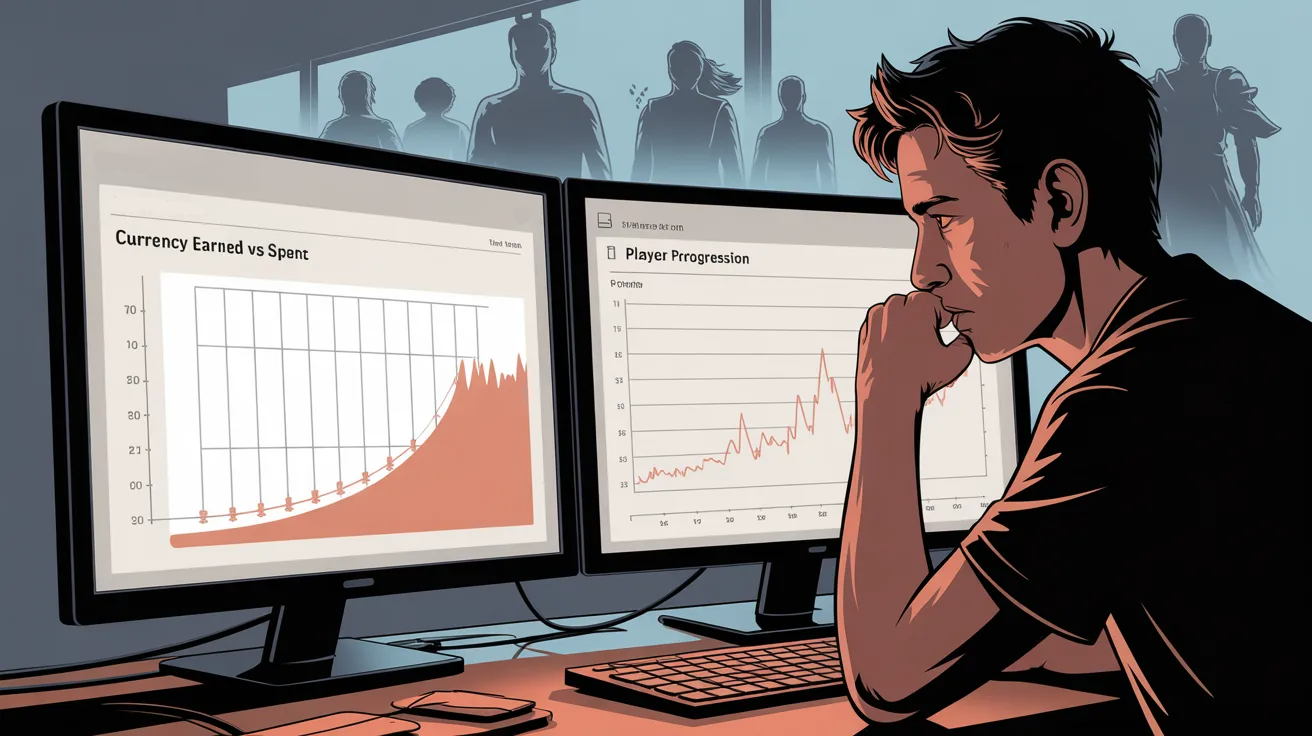
An economy is healthy when faucets and sinks stay balanced.
- Faucets = ways players earn currency (quests, dailies, battle pass, ad rewards)
- Sinks = ways players spend currency (shop items, progression timers, crafting, upgrades)
When faucets exceed sinks too much, players hoard currency. Offers lose urgency. Revenue softens first, then retention follows.
When sinks exceed faucets, players feel gated. Frustration rises. Churn accelerates.
The target: a 1.10–1.25 ratio (early game) to 1.05–1.10 (late game). Players earn slightly more than they spend — but not so much that accumulation feels meaningless.
Lehdonvirta & Castronova's Virtual Economies: Design and Analysis demonstrated that this balance predicts retention more reliably than raw engagement metrics — especially for mid-tier players who become your whales if they stay long enough.
Why This Is a Leading Indicator
Economy imbalance predicts churn 2–4 weeks before it shows in your cohorts.
Here is the sequence:
- Week 1: Players notice offers feel expensive relative to what they've earned. Engagement dips slightly.
- Week 2–3: Spend rates decline. Players rely on accumulated reserves instead of buying new currency.
- Week 4: Late-game players reach content with no reason to spend. They stop logging in or churn entirely.
By the time your retention dashboard screams, the economy failure is ancient history.
77% of churned players cite poor balance between gameplay and monetization as their primary reason for leaving (Mistplay, Mobile Gaming Growth Report, October 2024). Not poor content. Not bad ads. Economy imbalance.
Meanwhile, studios that monitor economy health catch inflation in week 1 and fix it before churn manifests. Adrian Crook's research shows these studios achieve up to 45% higher long-term retention with zero additional UA spend. That is not marginal improvement. That is structural advantage.
How to Monitor Economy Health (Without a Data Team)
You do not need a data scientist. You need four custom events and 30 minutes weekly.
The Four Events
Add these to Firebase or GameAnalytics:
- currency_earned — amount earned, source (quest, daily, ad, battle pass), progression tier
- currency_spent — amount spent, sink type (progression timer, shop, crafting, upgrade)
- player_balance_snapshot — soft currency balance, hard currency balance, progression level (daily, UTC midnight)
- milestone_reached — milestone name (level 50, tower unlock, boss defeat), days to reach it
That is all. No cohort analysis. No ML. No expensive tools.
The Dashboard (One Week to Build)
Once you have a week of data, build a simple daily sheet:
| Metric | Calculation | Warning Signal |
|---|---|---|
| Faucet-Sink Ratio | sum(earned) ÷ sum(spent) | >1.30 or <1.05 |
| Median Soft Currency | Daily median balance per active player | Rising >5% week-over-week |
| Progression Pacing | Days to reach level 50 by cohort age | New cohort 20%+ faster |
| Ad Dependency | % of daily earned from ads vs. gameplay | >40% signals fragility |
Real Examples: How Studio Leaders Do This
Path of Exile: Seasonal Rebalancing
Path of Exile resets its economy every 3–4 months. The team measures one metric weekly: how long does a casual player take to reach level 70? Expected: ~20 hours.
If time-to-level-70 drops below 16 hours, they have detected inflation. Players progress too fast. Endgame feels trivial. Churn risk rises. They adjust drop rates or add endgame sinks the following week — before players experience the problem.
Result: 78% D30 retention across seasonal leagues, among the highest in ARPG history.
Clash of Clans: Anchor-Based Sinks
Clash ties monetization to gameplay timers. Upgrades take 4–8 hours. Active play takes 3–5 minutes. Players choose: wait (time) or pay gems (hard currency).
The economy stays healthy when the gem-to-time price ratio feels fair. If upgrades suddenly require 12 hours instead of 8, time sinks increase. Monetization friction rises. Churn follows. Supercell monitors this ratio weekly and rebalances quarterly.
Game of War: Intentional Inflation for Engagement
Game of War deliberately inflates to keep whales engaged. If top-1000 players have 10x the power of top-2000, the economy is healthy (incentivizing whale spend). If the power gap compresses, they have lost their endgame sink. Whales stop spending.
They monitor whale behavior separately and introduce new spending tiers or cosmetics when compression is detected.
The Weekly Ritual (30 Minutes, Every Monday)
- Pull last week's dashboard. Check faucet-sink ratio, median balance, progression pacing.
- Compare to your benchmark. Is ratio in the 1.10–1.25 range? Are new players progressing within 10% of old cohorts?
- Flag anomalies. Ratio at 1.35? Progression 20% faster? Log a task for the dev team.
- Plan rebalancing. If ratio drifts, decide: reduce faucets (harder dailies), add sinks (cosmetics, timers), or both.
- Deploy in next patch. Make the change. Monitor the following week.
That is the entire workflow: 30 minutes of focus, one file to track. No spreadsheets. No meetings.
Why Whales Are Your Economy's Canary
What Not to Do
Don't assume revenue means the economy is healthy. Revenue can stay strong even as inflation builds. Players hoard currency. Offers become less effective. One content update later, retention collapses.
Don't wait for retention cohorts to confirm the problem. You are already weeks behind. Your economy dashboard flags issues on Monday. Your retention dashboard confirms them on Friday — too late to fix early.
Don't rely on ad-driven faucets. If more than 40% of soft currency comes from rewarded video, your economy is fragile. CPM volatility, platform changes, and user fatigue create churn risk outside your control.
Implementation Timeline
Week 1: Audit. List all faucets and sinks. Estimate current earn/spend rates. One spreadsheet, no coding required.
Week 2–3: Instrument. Add 4 custom events to your analytics. Start logging daily data. No analysis yet — just collection.
Week 4: First Dashboard. Aggregate 2 weeks of data. Calculate faucet-sink ratio, median balance, progression pacing. Compare to your Week 1 estimates.
Ongoing: Weekly Review Cadence. Every Monday: 30-minute review. Check for ratio drift, progression acceleration, whale behavior changes. Flag anomalies as rebalancing tasks for the development team.
Economy health is a measurable, actionable KPI that small studios can own without hiring extra headcount.
Games with balanced economies retain 45% more players. They experience churn 2–4 weeks later than unbalanced games (giving you time to fix). They avoid emergency sales that players resent.
You do not need a data scientist. You need 4 hours to instrument. Then 30 minutes weekly on monitoring. That efficiency is your competitive advantage.
Add economy health to your weekly review ritual. Your retention cohorts — and your revenue — will thank you.
The Indie Studio Monetization Playbook walks through the exact signals, review cadence, and decision trees discussed here — with templates for setting up your own dashboard.