For indie F2P studios at 1K–10K DAU
The Problem Nobody Instruments
Your players sit on 12,000 coins. Your best offer costs 1,000. That is not a bargain. That is noise.
This happens at almost every indie studio. You ship with a reasonable economy. Quest rewards feel good. Upgrade costs feel balanced. Everything tracks fine for the first month.
Then players accumulate more currency than your biggest offer costs. Offers stop feeling valuable. Conversion collapses. You assume the problem is your offers — so you adjust pricing. Revenue still drops.
The framework that fixes this is called faucets and sinks. It comes from virtual economy research (Lehdonvirta & Castronova, 2014) and from live operations teams at studios like EVE Online and Supercell. It sounds technical. It is not. You do not need an economist. You need a spreadsheet, basic arithmetic, and a clear mental model.
What Faucets and Sinks Actually Are
Faucets (sources or taps) put currency into players' hands:
- Daily login rewards
- Quest and mission completions
- Level-up bonuses
- Battle pass progression
- Event rewards
- In-app purchases of hard currency
- Rewarded video views
- Achievement payouts
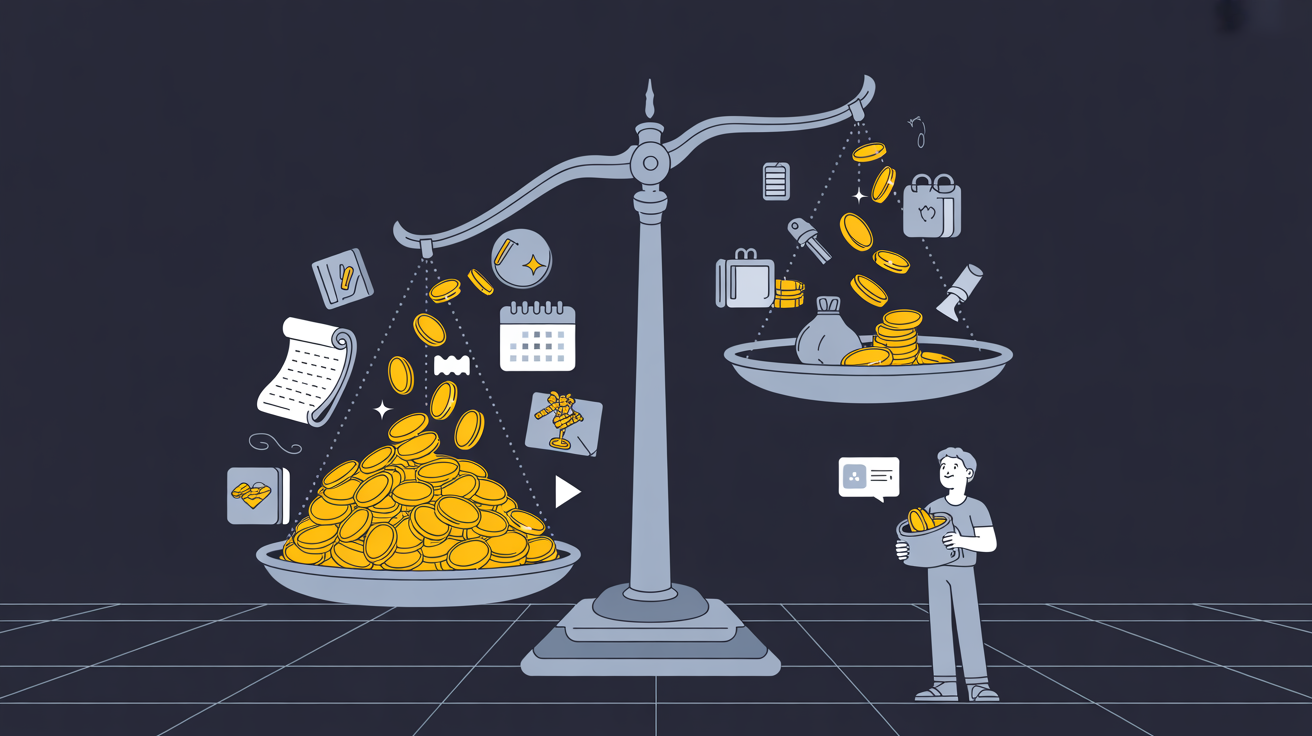
Think of a faucet as a water tap. Currency flows into the wallet.
Sinks (drains) remove currency from circulation:
- In-game purchases of items or upgrades
- Crafting and upgrading costs
- Gacha and loot box spends
- Energy or stamina refills
- Cosmetic shop purchases
- Battle pass premium tiers
- Time acceleration (skip timers)
- Consumables that deplete and require repurchase
A sink is the drain. Currency flows out of the wallet.
If sinks exceed faucets, the opposite happens. Players feel perennially broke. They cannot afford progression without spending. This creates the "pay-to-win" perception that drives negative reviews and accelerates churn.
Why Balance Matters: The Designed Scarcity Window
Properly balanced economies show 45% higher long-term retention than inflated economies (Adrian Crook, directionally consistent with Lehdonvirta & Castronova 2014).
For a studio at 5,000 DAU with 40% retention week-over-week, a 45% retention lift is not marginal. That is the difference between sustainable long-term growth and slow decline.
The goal is a designed scarcity window. Players should feel mild resource pressure at key progression points — where contextual IAP offers naturally land. They should never feel so squeezed that progression feels unfair.
Here is what this means in practice:
Early game (levels 1–20): Faucets can exceed sinks 1.25:1. Players should feel abundant. Progression is fast. Monetization friction is low.
Mid game (levels 21–50): Ratio tightens to 1.15:1. Resource pressure builds. Offers start to feel relevant. This is where casual spenders convert.
Late game (levels 50+): Ratio drops to 1.05:1. Players earn slightly more than they spend, but new high-cost content creates spending pressure. Whales stay engaged.
Clash of Clans maintains exactly this pattern. New players progress freely. Mid-tier players face the first monetization pinch: 8-hour upgrades demand 4-hour gem conversions. Top players have permanent progression sinks. Result: among the highest D30 retention rates in the strategy genre — Clash has maintained 40%+ D30 retention for over a decade.
The Single Most Important Audit for Your Studio
Most indie studios instrument their faucets. They track daily login bonuses, quest payouts, and level-up rewards in a spreadsheet. They know exactly what goes out.
Almost no indie studio instruments their sinks. They do not know where currency actually leaves the economy. Upgrade costs, shop purchases, crafting expenses — they are unmeasured.
This gap is the mistake that kills economies.
A basic faucet-sink audit measures four signals:
Signal 1: Total Currency Injected Per Active Player Per Day
What is your daily faucet rate? Add up: daily login bonus (e.g., 100 coins), average quest payouts (e.g., 50 coins × 3 quests = 150 coins), level-up bonuses (e.g., 200 coins when you level), event grants (e.g., 500 coins across the month, spread daily).
Example: 100 + 150 + 30 (level amortized) + 15 (events amortized) = 295 coins per day per player.
Signal 2: Total Currency Removed Per Active Player Per Day
What is your daily sink rate? This requires either a manual audit (list every upgrade cost, shop price, crafting expense) or an analytics query on your currency_spent events.
Example result: 280 coins per day per player.
Signal 3: Net Position — Faucet Rate Minus Sink Rate
In the example: 295 − 280 = +15 coins per day per player.
Over 14 days, your average player accumulates 210 coins. If your biggest offer costs 500 coins, players reach that price in 24 days. At day 10, they have 150 coins saved. Offers at that tier feel distant — not urgent.
This is the inflation signal. It is measurable. It is actionable.
Signal 4: Median Wallet Balance by Cohort, Week-Over-Week
- Growing cohorts: wallet growing every week → faucet excess. Add sinks or throttle rewards.
- Shrinking cohorts: wallet shrinking → sink excess. Players feel starved. Add faucets or reduce costs.
- Stable cohorts: wallet staying flat → balanced economy. Keep monitoring.
How to Run This Audit (30 Minutes, No Data Team)
Step 1: Manual faucet tally (5 minutes). List every way players earn currency. Add up your daily rate for an average active player.
Step 2: Analytics sink query (10 minutes). Pull your currency_spent events from Firebase or GameAnalytics. Calculate total spent ÷ active players ÷ days.
Step 3: Calculate net position (2 minutes). Faucet rate minus sink rate. That is your daily net accumulation per player.
Step 4: Pull wallet cohorts (8 minutes). Query player_balance_snapshot by cohort age (day 7, 14, 21). Check for growth, shrinkage, or stability.
Step 5: Compare to benchmark (5 minutes).
- If net position is +50 or higher → faucet excess, inflation detected
- If net position is −50 or lower → sink excess, players feel starved
- If net position is −20 to +20 → balanced, monitor weekly
Warning Signs: What to Look For
Wallets growing 3+ weeks straight. Your faucets are outrunning sinks. Action: Add high-value sinks (cosmetic shop, battle pass, new upgrade tiers) or reduce reward sizes by 10–15% this week.
IAP conversion declining while DAU holds steady. Wallet-too-full signal. Players are not buying because they feel rich. Action: Add sinks before you adjust pricing. Pricing changes rarely fix inflation.
Payer LTV dropping in month 2–3. Early payers depleted their currency on existing sinks. No new expensive sinks exist. Action: Ship new cosmetics, battle pass tiers, or seasonal content that demands currency this month.
New players reaching endgame 20%+ faster than old cohorts. Your faucets inflated or sinks were removed. Action: Check for unintended reward increases or drifting upgrade costs. Rebalance this week.
Real Examples: How Studios Keep Economies Healthy
Path of Exile: Weekly Pacing Monitoring
Path of Exile resets its economy every 3–4 months (seasonal leagues). The dev team tracks one metric: how long does a casual player take to reach level 70? Expected: 20 hours.
If time-to-level-70 drops to 16 hours, inflation detected. The team adjusts drop rates or adds endgame sinks the following week — before players experience underscarcity.
Result: 78% D30 retention across seasonal leagues, among the highest in ARPG history.
Clash of Clans: Anchor-Based Sink Tuning
Clash ties monetization to gameplay timers. Upgrades take 4–8 hours. Active play takes 3–5 minutes. Players choose: wait (time) or pay gems (hard currency).
Supercell monitors the gem-to-time ratio weekly and rebalances quarterly. This consistency is why Clash maintains 45%+ D30 retention year after year.
EVE Online: Transaction Tax as Primary Sink
EVE Online removes approximately 6.2% of daily currency via transaction fees (1% broker fee + 5% sales tax). This is their largest currency sink — more powerful than any shop or consumable.
By making the economy's largest drain invisible (a tax, not a shop purchase), EVE keeps players engaged while managing inflation at the macro level.
For indie studios: you do not need sophisticated sinks. Transaction taxes, seasonal cosmetics, time-gated upgrades all work. The key is measurement.
The Weekly Ritual (30 Minutes, Every Monday)
- Pull last week's dashboard. Check net position, median balance growth, progression pacing.
- Compare to your benchmark. Is net position in the +5 to +25 range? Are wallets growing less than 2% week-over-week?
- Flag anomalies. Net position at +60? Wallets growing 5% weekly? Log a task for rebalancing.
- Plan rebalancing. Decide: reduce faucets, add sinks, or both.
- Deploy in next patch. Make the change. Monitor next Monday.
That is the entire workflow. 30 minutes of focus. One file to track.
What Not to Do
Do not assume revenue means the economy is healthy. Revenue can stay strong even as inflation builds. By the time revenue cracks, your economy has been broken for weeks.
Do not wait for retention cohorts to confirm the problem. Your economy dashboard flags issues on Monday. Your retention dashboard confirms them on Friday. By then you are reacting, not preventing.
Do not rely on offer pricing alone to drive conversion. If wallets are full, cutting prices makes offers cheaper — not more valuable. Players still skip them. Add sinks instead.
Do not let ad-driven rewards exceed 40% of soft currency earnings. If rewarded video is your primary faucet, your economy is fragile. CPM volatility, platform changes, and ad fatigue create churn risk outside your control.
The Takeaways
- Faucets and sinks are two sides of the same economy. You cannot balance one without measuring both.
- Currency inflation is invisible until your conversion rate tells you. Audit your wallets before you assume your offers are bad.
- This audit requires no data science team. A spreadsheet, a basic analytics query, and 30 minutes per week is sufficient.
- The designed scarcity window is your target. Players should feel mild pressure at monetization moments, not panic or indifference.
- If you measure this week, you can act by end of month. Currency rebalancing does not require a client rebuild. Most adjustments ship as config changes.
The Indie Studio Monetization Playbook walks through the exact signals, measurement cadence, and decision trees discussed here — with templates for setting up your own dashboard.