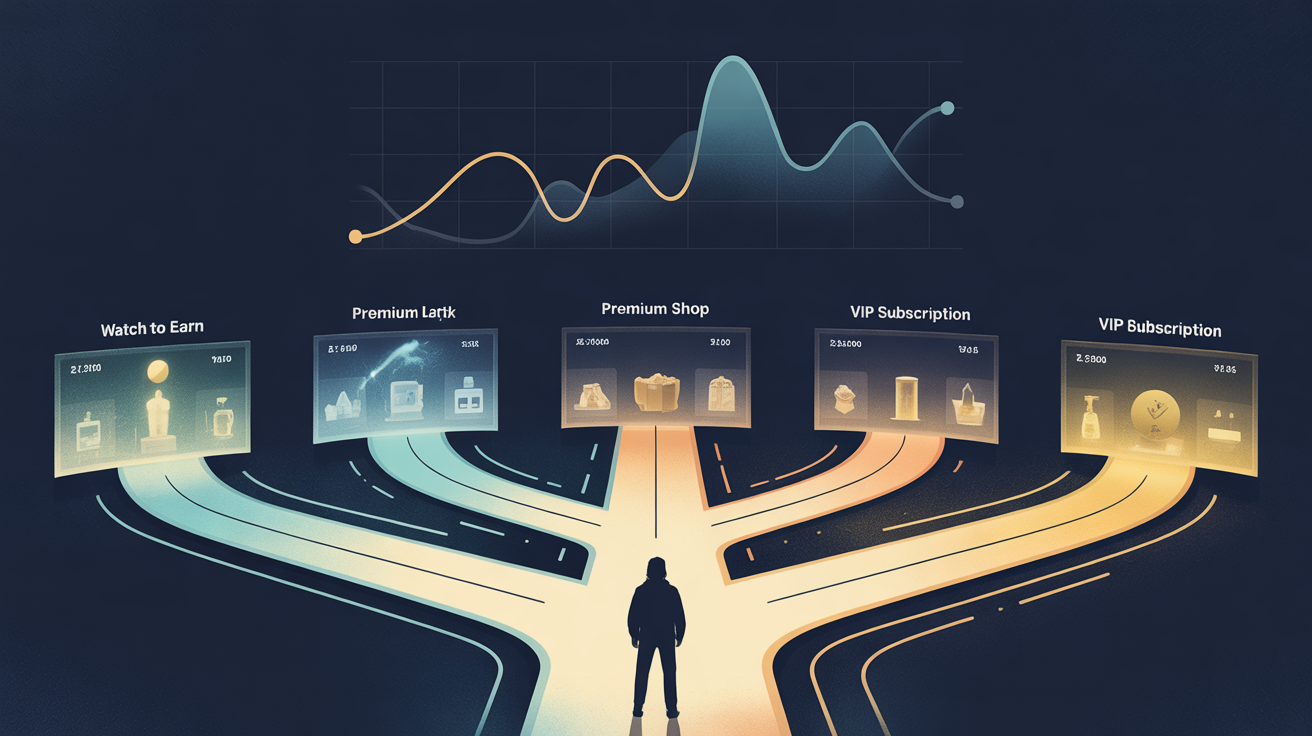
The old "ads vs. IAP" argument is effectively over. In 2026, the strongest studios are designing adaptive systems that blend in-app purchases, rewarded advertising, and live-ops offers by player segment and context.
The reason is straightforward: spend is rising while install growth stays flat. Sensor Tower reports global mobile consumer spend reached $150 billion in 2024, up 13% year-over-year, the strongest growth since 2021. Mobile gaming IAP hit roughly $81–82 billion, up about 4%, even as downloads declined to around 49 billion. Hybridcasual IAP revenue alone grew 37% year-over-year.
The headline: monetization quality has become more important than top-of-funnel scale. Studios are generating more value per engaged user without material download growth. If your strategy still treats monetization as a static economy setting instead of a real-time decision engine, you are likely leaving both revenue and retention on the table. (We break down exactly why same-offer-for-everyone kills revenue in a companion piece.)
What Hybrid Monetization 2.0 Actually Means
Most teams already run "hybrid monetization" in a basic sense (ads plus IAP). Hybrid Monetization 2.0 is different in three ways:
- Segmented value exchange: Different players see different monetization pathways based on intent, progress, and spend propensity.
- Contextual delivery: Offer timing is optimized around gameplay state (win/loss, session depth, progression choke points), not generic timer triggers.
- Experiment-driven orchestration: Ad load, offer ladders, and bundle structures are tuned continuously through controlled testing, not quarterly planning cycles.
What this means for your team: your economy is no longer a fixed design artifact. It becomes a live system balancing short-term ARPDAU with long-term retention and payer conversion.
From Monetization Features to Monetization Systems
Many studios still implement monetization as disconnected features: a starter pack, rewarded ad placements, an event pass, a few discount offers. That stack can produce revenue, but it rarely scales efficiently because each feature optimizes for itself.
Hybrid 2.0 teams define monetization at the system level. A useful operating model is a three-layer architecture:
Layer 1: Audience Segmentation
At minimum, split players into behavioral cohorts: ad-engaged non-payers, low-frequency converters, repeat spenders, high-LTV progression-focused users, and churn-risk users.
The goal is not demographic profiling. It is identifying each cohort's preferred value exchange. Some users will trade time for rewards (ads). Others will trade money for speed or exclusivity (IAP). Your model should respect both.
Layer 2: Monetization Paths
Design explicit paths per cohort:
- Ad-depth path: Reward multipliers, extra turns, revive offers, low-friction utility boosts.
- Conversion bridge path: Entry-value bundles tied to immediate utility, often triggered after meaningful friction moments.
- Whale protection path: High-value premium offers with reduced ad pressure to prevent experience degradation for top spenders.
Layer 3: Optimization Loop
Run continuous A/B or multi-armed bandit tests on ad frequency caps, rewarded placement timing, first-purchase bundle composition, dynamic pricing windows, and progression-linked offer triggers.
This is where monetization personalization becomes a compounding advantage. Studios that automate this loop, using contextual signals to decide what to show, when, and to whom, consistently outperform teams running manual offer rotations.
Where Studios Still Get It Wrong
Despite strong market signals, three recurring mistakes keep showing up:
1) Copying genre norms without validating player economics
A monetization design that works for one hybridcasual hit may fail in another due to different progression pacing and session lengths. Genre benchmarks are useful priors, not ground truth.
2) Over-optimizing day-1 conversion at the expense of day-30 value
Aggressive early discounting can inflate conversion metrics while suppressing medium-term spend depth. Teams that win in 2026 increasingly optimize for contribution margin over longer windows, not first-week spikes.
3) Treating ad pressure as "free revenue"
Poorly timed interstitials remain one of the fastest ways to harm retention. Rewarded value exchange generally preserves goodwill because the player opts in. The tradeoff is that rewarded systems demand better economy design to avoid inflation and reward cannibalization.
A Practical 90-Day Plan for Decision-Makers
If you are leading product, monetization, or live ops:
Days 1–30: Diagnose monetization fit
- Build a cohort-level monetization map: ARPDAU, payer conversion, ad engagement, and retention by segment.
- Identify one high-volume non-paying cohort and one high-potential converting cohort.
- Quantify where your current ad/IAP mix over- or under-performs by segment.
Days 31–60: Launch targeted experiments
- Test one conversion bridge offer for ad-engaged non-payers. For example, a $1.99 resource pack triggered after the third failed boss attempt.
- Test one ad-load reduction strategy for high-value spenders.
- Test trigger logic tied to gameplay state rather than fixed timers.
Keep experiment scope tight. One variable family per test is better than shipping a large monetization rewrite that obscures causality.
Days 61–90: Operationalize winners
- Productize winning triggers and offer templates.
- Add guardrails for economy health: sink/source ratios, inflation checks, reward velocity.
- Institutionalize weekly monetization reviews that jointly evaluate revenue and retention.
Studios that operationalize this loop move faster than teams that treat monetization as quarterly event planning.
The Strategic Opportunity for 2026
Newzoo's 2025 forecast estimates $188.8 billion in total game revenue globally, with mobile still the largest segment at $103.0 billion (about55% share). Spending is resilient, but user growth is no longer a reliable crutch.
That means monetization personalization is not a "nice-to-have" optimization layer. It is core strategy. The studios that outperform over the next cycle will be those that can simultaneously protect player experience, increase value capture per engaged user, and adapt rapidly through experimentation.
When players feel fair value exchange, monetization becomes less of a tax and more of a service layer in the game economy.
Hybrid Monetization 2.0 comes down to aligning business outcomes with player intent. That is the difference between short-lived spikes and durable growth.