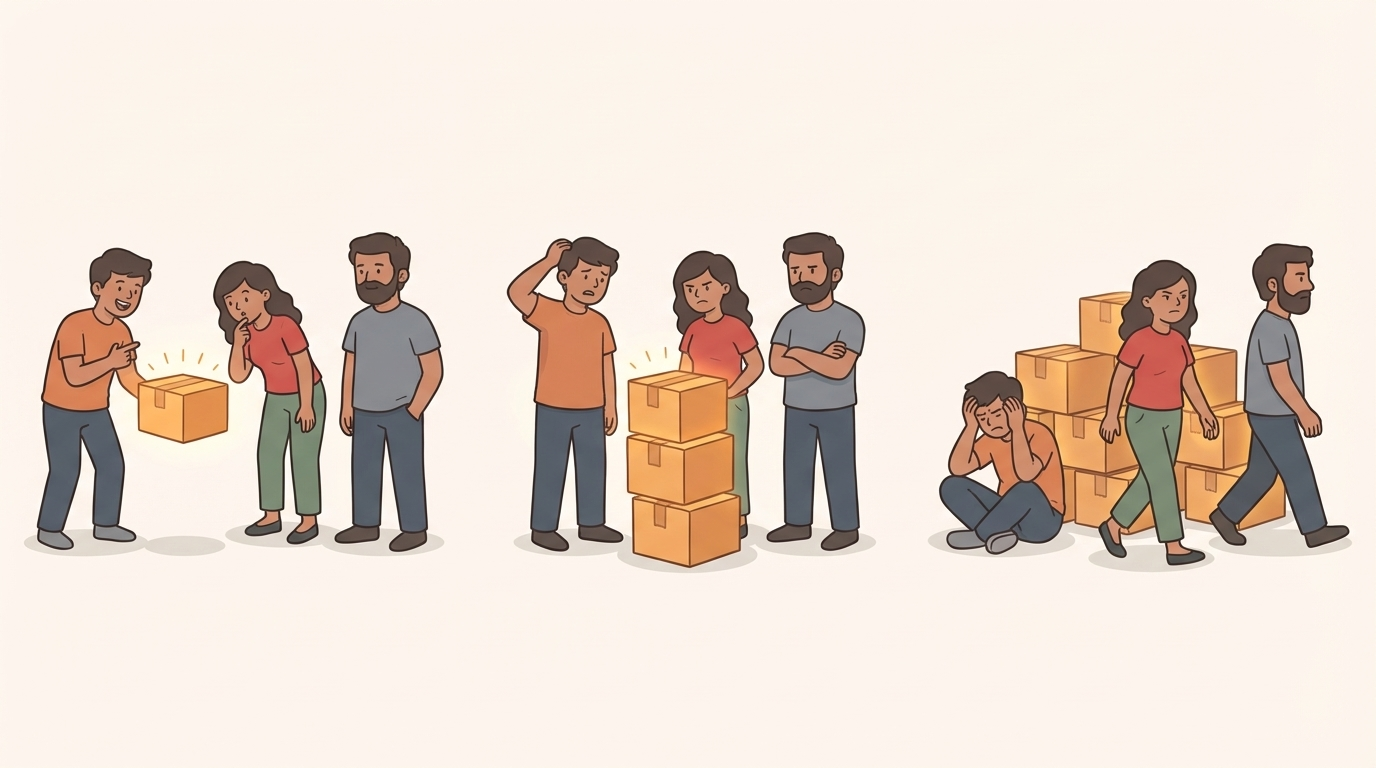
Most game teams don't lose monetization upside because they lack effort. They lose it because they ship one static economy and expect every player to respond the same way.
A single default offer stack — same prices, same bundles, same timing, same placements — feels operationally simple. But the player base is not simple. Some players are first-week explorers. Some are lapsed returners. Some are ad-tolerant but price-sensitive. Some convert only when urgency and relevance align. Treating all of them identically leaves money on the table — and often hurts retention at the same time.
For indie and mid-size studios, this matters more than ever. User acquisition is expensive. Organic discoverability is inconsistent. Platform fees don't get cheaper. Revenue expansion has to come from better conversion efficiency and higher lifetime value per acquired player — not just more installs.
Static offers are operationally clean, economically inefficient
Static offer design usually looks like this: one starter pack for all new users, one cadence of shop popups, one discount calendar, one "best value" bundle repeated across cohorts.
This can work as a baseline, but it breaks at scale because player motivation and spending readiness vary by context — progression state, session intensity, historical spend behavior, current game mode goals, local purchasing power, and elapsed time since last meaningful reward.
When these differ, offer elasticity differs. If you keep price and packaging constant, you underprice some demand and overprice the rest.
The result is a double miss:
- Low-intent players see irrelevant offers and ignore them.
- High-intent players who might spend more are capped by generic packaging.
You don't just lose conversion. You lose revenue quality.
The market already tells us precision matters
Sensor Tower's State of Mobile Gaming 2025 report shows mobile gaming IAP reached roughly $81 billion in 2024, up 4% year-over-year, even as downloads continued to decline. In a market that large and efficiency-driven, broad-stroke monetization leaves too much on the floor.
Spender behavior data reinforces the same message. Mistplay's 2024 Mobile Gaming Spender Report found:
- 33% of spenders said they will spend when they see a deal "too good to pass up."
- 40% said they would be influenced to spend more with personalized offers.
- 32% of spenders (and 41% of high-value spenders) planned to reduce in-game spending — increasing the need to target value precisely.
If intent is selective, offers must be selective too.
Why segments respond differently to pricing and packaging
Studios often segment only by spend tier (non-payer, minnow, dolphin, whale). That's useful, but incomplete. Better offer performance comes from combining spend with behavior and context.
Progression-driven segments. Players blocked at a difficulty spike respond differently from players in flow. The first group values friction removal; the second values acceleration or status.
Motivation-driven segments. Collectors, competitors, social guild players, and builders each assign value differently. A cosmetic-heavy bundle can outperform a utility bundle in one segment and underperform in another.
Timing-driven segments. A returning player on day 14 behaves differently than a day-2 new user, even at the same spend history. Offer timing windows matter as much as offer content.
Price-sensitivity segments. Two players may both buy, but with different trigger points. One converts at full value with convenience framing. Another needs discounted anchoring or bonus framing.
When teams ignore these differences, monetization is a volume game. When teams model them, monetization becomes a relevance game. For a deeper look at how to structure segmented monetization paths — blending IAP, rewarded ads, and live-ops by cohort — see our hybrid monetization playbook for 2026.
Where static-offer systems leak revenue in practice
Leakage #1: Universal starter packs. One starter pack for all new users assumes identical willingness to pay in week one. In reality, newcomers split into explorers, optimizers, and high-intent accelerators. One bundle won't fit all.
Leakage #2: Fixed shop sequencing. If every player sees the same offer order, you compress potential. Some cohorts should see value-first utility offers; others respond better to social or status bundles.
Leakage #3: One discount policy. Global discounting trains behavior and can cannibalize full-price demand. Targeted discounting preserves margin while still activating price-sensitive segments.
Leakage #4: No returner strategy. Lapsed returners are often treated as net-new players. They aren't. Their reactivation path and offer relevance should reflect prior progress and spend memory.
A practical rollout path for indie and mid-size studios
You don't need enterprise complexity to start. A focused rollout creates early lift quickly.
Phase 1: Establish baseline and guardrails (2–3 weeks). Define core metrics — payer conversion, ARPDAU, offer CTR, view-to-purchase rate, D1/D7 retention, complaint rate. Lock fairness rules. Create a clean control group.
Phase 2: Launch 3–5 high-impact segments (3–6 weeks). Suggested first cuts: new users by early session depth, non-payers by engagement intensity, lapsed returners by prior spend, active payers by category preference.
Phase 3: Personalize offer dimensions, not just price. Start with bundle composition, value framing, timing, placement frequency, and bonus structure. Price changes can come later — content and timing personalization alone often yields material gains.
Phase 4: Judge quality of lift, not raw lift. Measure incremental revenue (not gross movement), retention impact, payback on reward costs, and sentiment drift in support/community channels.
The takeaway
If your team still runs same-offer-for-everyone monetization, you're operating with a hidden revenue ceiling.
In 2026's market, growth comes less from "more of the same" and more from precision — precision in who sees what, when they see it, and how value is framed for each player.
Static offers are easy to ship. Personalized monetization is harder. But that difficulty is exactly where the advantage lives.
Studios that move first unlock a compounding edge: better conversion, better retention fit, and better learning loops over time.
The good news for indie and mid-size studios is that this no longer requires an enterprise team or a six-month build. The infrastructure exists to run segmented, adaptive offer personalization at your scale — without the overhead of a dedicated monetization team.
That's what Qyren is built for. We give indie and mid-size studios the same monetization intelligence that top-tier live-service teams run internally — offer personalization, economy health monitoring, and prescriptive recommendations — packaged as accessible AI infrastructure, not a consulting engagement.
If your studio is ready to move off one-size-fits-all monetization, see what Qyren can do at qyren.ai.