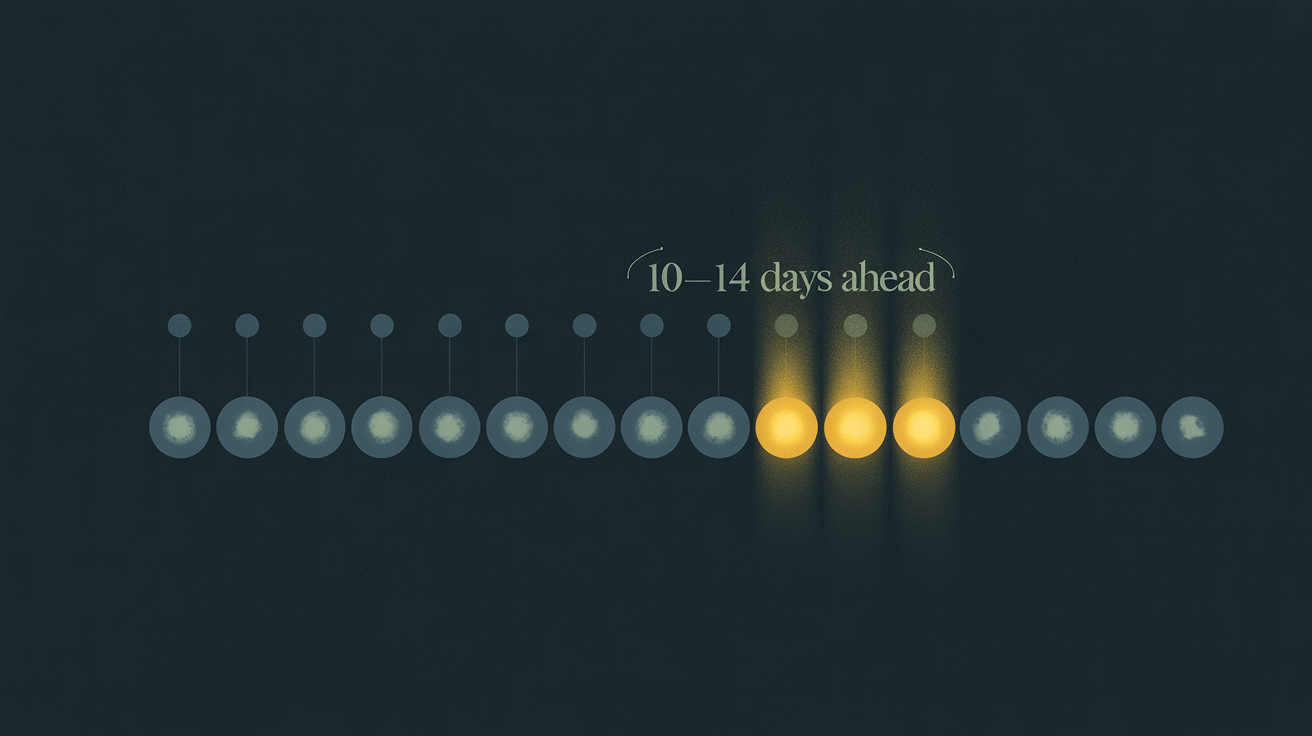
Most studios watch the outcome. The studios that move on revenue read the signal that arrives before the outcome.
Most studios see the outcome.
The signal arrives 10 to 14 days earlier.
The signal is what you can act on.
By the time payer conversion drops, the cause has already happened. By the time ARPDAU softens, the players who could have spent more have already moved on. The dashboard is reporting events that closed days ago.
The studios I work with that consistently grow revenue per active player are not running better dashboards. They are reading a different layer of data altogether. They watch behavioral signals that predict where revenue is about to move, then act before the outcome shows up.
I call this the Revenue Signal layer. It is not a feature anyone ships. It is a way of reading your own data that most studios have never been taught to look for.
What is a Revenue Signal?
A Revenue Signal is a behavioral indicator that predicts a monetization outcome before that outcome appears in revenue numbers.
The shortest definition: any pattern in player behavior that tells you what your revenue is about to do, while you can still affect it.
Player behavior produces a continuous stream of events. Sessions start and end. Currency moves between balances. Players hit walls and clear them. Some events tell you what already happened. A purchase, a churn, a refund. Those are outcomes. By the time you see them in a chart, they are settled.
Other events tell you what is coming. A player who spent four sessions clearing a difficulty spike and then disappeared for 18 hours is sending one signal. A player whose soft currency just dropped below the cost of the next progression action is sending another. A player who has logged in for ten consecutive days but has not made a purchase in two weeks is sending a third.
Each of these is a Revenue Signal. Each predicts a specific monetization outcome 10 to 14 days before that outcome shows up in aggregate metrics.
Outcomes are settled events.
Signals are pending events.
The studios that win at monetization are the ones that act on the second category, not the first.
Why most studios only see the outcomes
When I audit a small or mid-size studio's monetization data, the same pattern shows up almost every time. The team has analytics. The team has dashboards. The team can tell me their D7 retention, their seven-day ARPDAU, their payer conversion rate, their median session length. None of those numbers tell me whether revenue is about to grow or fall.
There are two reasons aggregate metrics hide the signal.
The first is mathematical. A 2.1% payer conversion rate across an entire player base is the average of dozens of micro-cohorts behaving very differently. The player on day 8 who just hit their first major friction point is not the same data point as the player on day 30 cruising through familiar content. Combining them into one number erases the information that would tell you what to do.
The second is operational. Even when a team can see the signal, the existing offer system cannot act on it. A static offer schedule fires the same bundle on day 7 regardless of what the player did on days 1 through 6. The system is not built to read the signal, so the signal is functionally invisible at the point where it would matter.
This is why I see studios at 5K to 50K DAU running monetization that looks like a calendar. The events fire on time. The offers go out. Conversion stays stuck somewhere between 1.5% and 2.5%, and the team blames the price.
The price is rarely the problem. The signal layer is.
The four signals worth tracking weekly
After looking at how studios across genres structure their monetization data, four signals show up repeatedly as the leading indicators of where revenue is about to move. They are not novel insights. They are observable in any decent analytics setup. They are simply not what most studios are watching.
Signal 1: Offer relevance
The percentage of your active player base that ever sees an offer designed specifically for their state.
This is the single most predictive signal of long-run conversion. Mistplay's 2024 Mobile Gaming Spender Report found that 40% of mobile spenders said personalized offers would influence them to spend more. That is the public version of a number you can measure in your own game. Your version is the share of players who are currently receiving an offer that was triggered by their behavior versus an offer that fired on a calendar.
If the answer is below 5%, your conversion ceiling is not a price problem. It is a coverage problem. No price test will fix it.
Signal 2: Progression friction
The behavioral state of players approaching, hitting, or recovering from a difficulty spike.
Friction is a monetization moment, not a churn moment. Unity's 2024 Mobile Growth and Monetization Report showed that offering a relevant prompt when players run out of resources converted at 38.1%, against 23.8% between levels. The same logic applies to IAP. The player who just failed Level 9 twice in one session is sending a clear signal about willingness to pay for help. The player browsing a static shop after a calm session is not.
Most studios measure how many players hit a friction point. The signal is what those players do in the next 10 minutes.
Signal 3: Economy pressure
The state of currency balances, sink-faucet ratios, and price elasticity at the player level, not the aggregate.
A healthy economy at the cohort level can hide unhealthy economies inside it. The classic case: average soft currency balance looks fine, but the median is collapsing while a small cohort of long-tenured players hoards. The aggregate stays stable. The mid-life cohort is starving. Conversion drops there first.
The signal is the share of your active players whose currency state is below a meaningful purchase threshold for the next progression action they will attempt.
Signal 4: Re-engagement readiness
The behavioral profile of returning players in their first session back.
A returning player is a different person than a player on a continuous streak. The day-21 player who just came back after a four-day gap is in a state where the right offer can convert at two to three times the rate of a continuously engaged player on the same day. The wrong offer, or no offer, sends them away again.
This signal is the share of your daily active base that is in a re-engagement state, and what those players see in their first 90 seconds.
Each of these signals exists in your data already. The question is whether anything in your offer system can read them.
What changes when you read signals instead of measuring outcomes
Studios that move from outcome-watching to signal-reading change three things in their workflow.
The weekly meeting changes. The dashboard review stops being "what happened to revenue last week" and becomes "which signals shifted this week, and what offer logic should respond." The team stops debating why D7 dropped two points and starts looking at which cohort is currently building toward the same drop.
The offer system changes. Fixed schedules give way to triggered offers that fire when a signal crosses a threshold. The team stops shipping a Day 7 starter pack and starts shipping a starter pack that fires when a player has logged at least three sessions, has not yet purchased, and has soft currency below the cost of their next progression action.
The conversion math changes. The headline conversion number stops being the only thing that moves. Conversion within the high-intent cohort climbs first, attach rate climbs second, average revenue per paying user climbs third. The aggregate number finally moves a few weeks later, but by then the team already knew it would.
This is why studios that read signals tend to see 20-30% uplift in IAP revenue from behavioral offer timing. The lift is not in finding new players. It is in capturing willingness to pay that was already in the room and previously walked past unmatched.
The lift is not in finding new players. It is in capturing willingness to pay that was already in the room and previously walked past unmatched.
The accuracy bar that makes signal-reading worth doing
A signal-reading system is only as good as how often it lands the right offer against the right state.
In production, I treat 87.5% as the working internal target for offer-to-signal matching. Below that bar, uplift compounds slowly because too many offers land against the wrong state. At or above that bar, every signal-triggered offer becomes a meaningful contribution to lift.
The number is not a public benchmark. It is the internal threshold I use to decide whether a personalization system is doing useful work. Studios building this in-house can set their own bar. The point is that the bar exists. Without it, the team is shipping triggered offers without knowing whether they are actually relevant.
What to do this week
One signal is enough to start.
The four signals are useful as a complete framework. As a starting point, one is enough. Pick the signal most likely to be leaking revenue in your current game and instrument the response.
| DAU band | Where to start | Why |
|---|---|---|
| Under 1K | Defer | The signal layer needs volume. Focus on retention and content quality first. |
| 1K to 10K | Signal 1 (offer relevance) | The fastest signal to instrument. Calculate what share of your active base receives a behavior-triggered offer, then move that number. |
| 10K to 50K | Signal 1 + Signal 2 | Layer in progression friction once relevance coverage is moving. Most uplift in this band comes from these two signals. |
| 50K to 250K | All four signals | Volume supports running all four in parallel. The compounding effect across signals starts to matter at this scale. |
For studios above 1K DAU, the practical bar is whether your current setup can fire a different offer based on the signal you are tracking. If it cannot, the signal is invisible at the point where it would matter, and the first move is fixing that.
The gap is rarely insight.
The gap is response.
A note on what Qyren is and isn't
The Revenue Signal framework is a way of thinking about your data. Qyren is one way to act on it.
If signal-reading makes sense after reading this, you have two paths. Build it. Or buy a system that reads the signals for you.
Building it requires a senior data scientist and an economy or product designer who can keep the matching loop running every week. That team typically lands at $270K loaded annual cost in EU and NA markets, which is the gating cost most indie and mid-size studios cannot justify before they have the revenue depth to absorb it. We broke down that math in The $270K Gap.
Buying it shifts the work to a platform that handles signal-reading and offer-matching directly. Qyren is built for studios in the 1K to 250K DAU band, with 7 days to integrate and 5 lines of SDK code.
If you want to walk through what the signal layer looks like in your specific game, email me at ramesh@qyren.ai.
Sources: Mistplay 2024 Mobile Gaming Spender Report (40% personalized offer influence). Unity 2024 Mobile Growth and Monetization Report (38.1% vs 23.8% friction triggers). Newzoo 2025 (~1.25% DAU conversion). Sensor Tower 2026 ($82B IAP, -7.2% downloads). 20-30% uplift and 87.5% matching bar are Qyren-verified internal benchmarks.