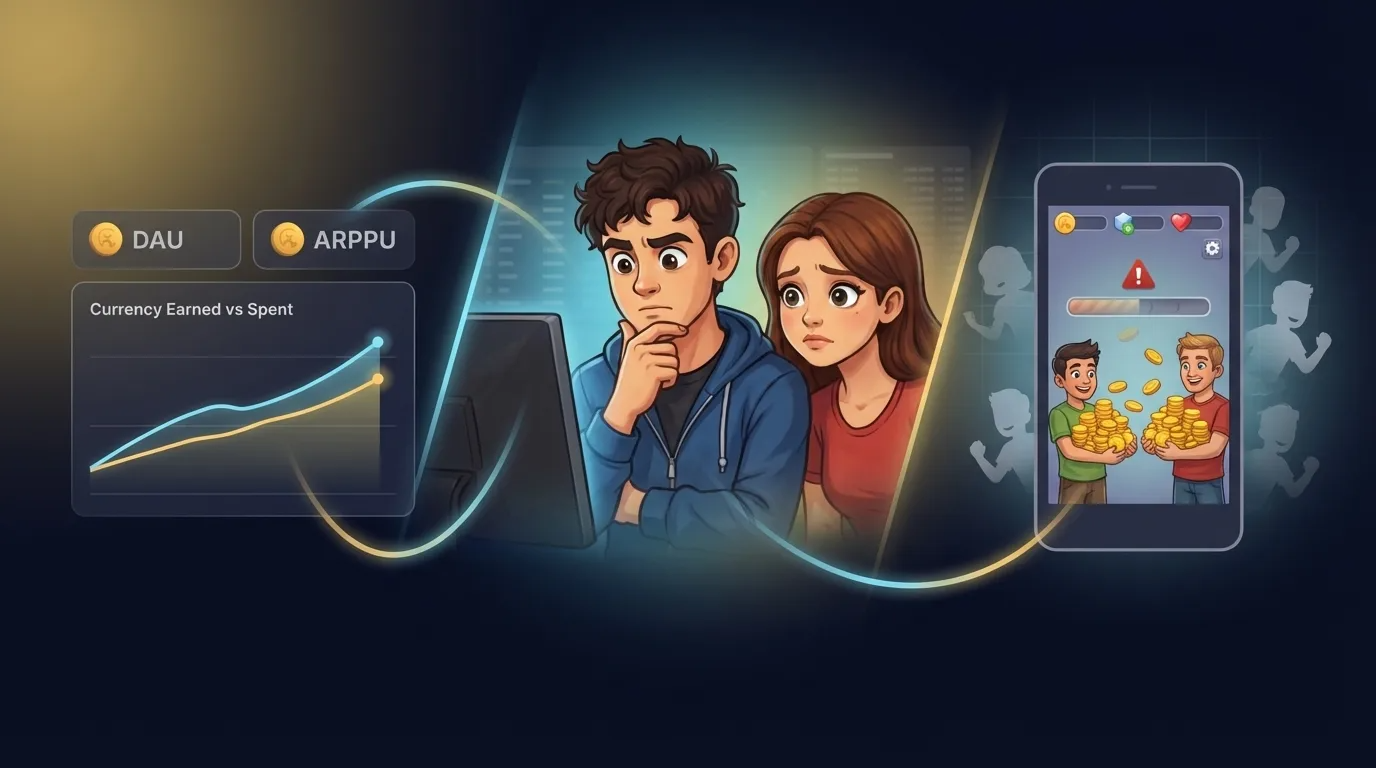
Your revenue is up. Your player base is flat or growing. But something feels wrong. Players spend less per session. Your best spenders log in less often. And your offer frequency has tripled in the last six months because nothing sticks anymore.
You're not growing. You're cannibalizing.
If this sounds like your game, three specific signals are breaking in sequence. Miss the first, and the third will kill you. Here's what to watch.
Sign 1: Weekly Active Payers Collapse While DAU Holds Steady
Your DAU is stable. Maybe even up. But weekly active payers are dropping week over week. This is the first sign your economy has broken.
Why? Because DAU measures traffic. WAP measures health.
A game can hold DAU while losing payers because one thing drives traffic and another thing drives monetization. New players onboard and boost DAU. Veterans quit the monetization loop. Net DAU looks flat. WAP tells the truth.
The data backs this up hard. 69% of spenders churn when games become too pay-to-win, and 78% of high-value spenders do the same (Mistplay 2024 IAP Spend Trends Report). These are players who already opened their wallets. They didn't leave because the game sucked. They left because spending stopped being fun or stopped being fair.
Day 1 retention for the top 25% of games dropped to 26–27%, down from 28–29% in 2023 (Gamigion Mobile Gaming Benchmarks 2025). That's a small absolute number, but it means veteran cohorts are disappearing faster. Your revenue graph looks stable because new players offset the churn. WAP shows the actual bleeding.
Sign 2: ARPPU Flatlines While Paying Share Drops
You're getting more revenue per payer, but fewer payers exist. Your ARPPU is stalling. Your paying share is dropping. This is the second warning.
The number: average annual spend per gamer hit $147 in 2024, up only 11% year over year from $132 (IconEra In-Game Purchase Statistics 2025). That's slower than inflation. Global IAP revenue grew just 4% year over year to $81 billion in 2024 after two straight years of decline (Sensor Tower 2025 State of Mobile). When the market grows 4% and you're flat or declining, you're losing share.
Here's what this looks like in your game: your ARPPU goes up because you're pricing harder. Tier 3 spenders disappear. Tier 1 spenders spend more to stay competitive. Net ARPPU is up, but the paybase shrinks. Revenue holds steady or grows because your Tier 1s are now Tier 2s, and they're spending what Tier 3s used to spend.
This is the pricing ceiling. You've hit it.
You know it's real when you're A/B testing offer prices and price elasticity breaks. A 20% bump that used to drive volume now drives refunds or churned cohorts. Your paying share drops because you've priced out the middle. You're left with addicts and tourists, no real economy.
Sign 3: Offer Fatigue Accelerates
Your conversion on monetization offers drops. Session reengagement offers stop working. You've added more offers to the game to compensate. Bounce rate in monetization funnels is creeping up. This is the final warning.
Paying users are increasingly single-purchase focused. Weekly active payers are replacing DAU as the real health metric for F2P games (AppsFlyer 2024 State of App Monetization). That's because the era of repeat spenders in a single session is ending. Players now decide to spend or not spend, then bounce.
Hybrid monetization adoption surged 20% in 2024; single-channel monetization is plateauing (AppsFlyer 2024 Gaming App Marketing Report). This means successful games are layering multiple monetization modes. Games that doubled down on a single lever — like the ones still running the same offer for everyone — are stalling.
Why does this matter? Because offer fatigue is the last warning before churn accelerates hard. You see it when offer-to-conversion ratio drops. You're showing 10 offers to convert 1 user, then 15, then 20. At some point, showing more offers doesn't work. It annoys. Then it kills retention.
What Breaks When You Miss These Signs
Ignore Sign 1 and WAP keeps dropping until you can't pay for user acquisition anymore. Unit economics get impossible.
Ignore Sign 2 and you squeeze pricing until your revenue graph inverts. The paying share collapses faster than ARPPU grows.
Ignore Sign 3 and your retention graph falls off a cliff. Players tune out. Session length drops. You're pushing dead offers to ghosts.
If all three are in motion at once, you have 2–3 months before revenue acceleration stalls and reversal begins.
The Real Fix Isn't More Offers
The reflex is to add more monetization. More offers, more battle pass tiers, new currencies, limited-time bundles. This is the trap. You're not growing your economy, you're mining it faster. The extraction is accelerating, not revenue.
The real fix is economy design: price structure, progression pacing, value perception per segment. That's a 4–6 week project, not a 4-day feature sprint. Most indie teams skip it because it's hard and invisible. Your players don't tweet about a better economy. They just stop churning as fast.
Start with the playbook: qyren.ai/playbook