Most studios spend the majority of their monetization design effort on the wrong window.
The roadmap looks reasonable on the wall: Day 1 onboarding, Day 7 retention milestone, Day 14 first IAP push, Day 30 economy review, Day 60+ live-ops calendar. The work scales with the window. The further out, the more design effort.
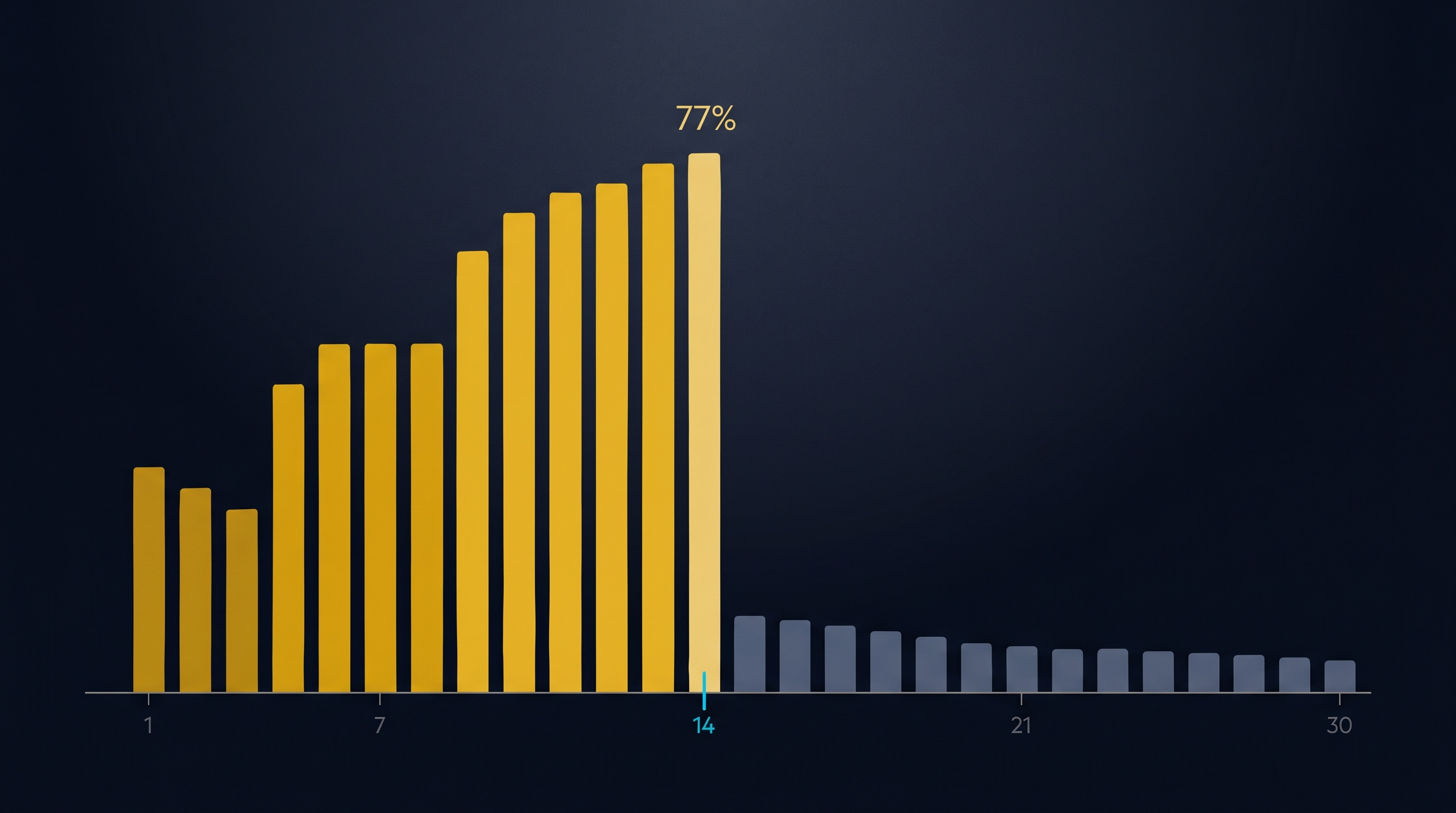
The data inverts this. According to Unity's 2023 Mobile Growth and Monetization Report, 77% of mobile players who ever make an in-app purchase make their first one within the first 14 days. By Day 21, that figure is 80%. Everything past Day 21 is whale retention work, not new payer acquisition.
Most monetization calendars optimize for the 20%. They allocate the bulk of design effort to a window that produces 20 cents of every payer dollar.
This is the inversion to fix.
The data that should rebuild your monetization calendar
Three studies converge on the same conclusion.
Unity 2023 Mobile Growth and Monetization Report. 77% of mobile players who make any IAP do so within the first 14 days. 80% by Day 21. The $1.01 to $5 range is the sweet spot for converting first-time payers.
Mistplay 2024 Mobile Gaming Spender Report. 34% of spenders make their first purchase within the first week. 77% within the first month. Two thirds of all paying players are converted by the end of Week 2.
Solar Engine (2024). First-time purchasers show 2 to 3x higher D7 and D30 retention compared to non-payers. The first purchase is not just a revenue event. It is a retention predictor.
The implication is structural. If 77% of payers convert in the first 14 days, then:
Day 1 to 14 is new payer acquisition. Day 15 to 30 is recent payer monetization. Day 30+ is whale retention. Three different problems with three different design requirements. Most studios collapse them into one roadmap and underbuild the most consequential window.
What "first 14 days" actually means
The 14-day window is not a single uniform period. It compresses three distinct sub-windows that produce different signals and require different responses.
Day 1 to 3: signal collection. The player is establishing baseline behavior. Session length, progression speed, social engagement, ad tolerance. No offer should fire in this window. Anything you show is uncalibrated.
Day 4 to 7: first offer window. Behavioral signals are now stable enough to act on. The player has revealed their willingness to engage, their pacing, and whether they have hit a friction point that creates a moment of relevance. 34% of all future spenders convert in this window. Get the offer right and you double the eventual payer base.
Day 8 to 14: relevance window. The next 43% of future spenders convert here. This is where most studios get the timing wrong. They fire offers on fixed timers (Day 7 starter pack, Day 14 first sale) instead of on behavioral signals. The conversion delta is wide. We covered the mechanics of why one-size-fits-all offer stacks leak revenue in a prior post.
Fixed timers assume identical players.
Why most studios get this inverted
There are three reasons the calendar gets backwards, and none of them are about belief. They are about org structure and tooling.
The live-ops calendar is built for retention, not monetization. Event calendars, battle passes, weekly content drops are designed to keep Day 30+ players engaged. The same team usually owns the monetization calendar. When the operational rhythm is weekly content drops, monetization defaults to weekly offer slots, which means most offers fire in the post-launch window where they matter least.
A/B testing infrastructure favors late-window iteration. Most testing platforms work best with stable cohorts. Day 1 to 14 players are by definition unstable cohorts. They are still revealing who they are. So tests get run on Day 30+ players where the statistics are cleaner. The trouble is, by Day 30 you are testing against the 20% of revenue, not the 80%.
The dashboard hierarchy mirrors the inversion. ARPDAU. LTV. D30 retention. D60 retention. The metrics reviewed every week are post-Day-14 metrics. The metrics that would matter most (first-purchase conversion rate by Day 4 to 7 cohort, first-offer relevance score, Day 1 to 3 signal coverage) usually do not exist in the standard reporting stack.
Tracking D30 retention is not the mistake. Treating it as a leading indicator is. By the time it shows up on a chart, the work that would have moved it has already happened or already failed.
The Day 1-14 playbook
The work splits cleanly across the three sub-windows. Here is what each one actually requires.
Day 1 to 3: collect, do not act
The mistake here is firing any offer at all. The Mistplay 2024 data is clear: 34% of spenders convert in the first week, but that is a population average. The individual variance is wide. Some players are ready to spend on Day 2. Most are not.
Show nothing. Collect the signal.
The signal you want includes session count and average length, progression rate (levels completed, milestones hit), friction encounters (level retries, time stuck on content), resource consumption rate, and ad engagement. Rewarded video opt-in rate is a strong willingness-to-engage proxy.
A player who has retried Level 5 four times by end of Day 2 is a different player than one who has progressed linearly. They need different offers. You will not know which is which until Day 3 at the earliest.
This is also when economy health monitoring starts paying off. Currency velocity, sink coverage, and resource pacing in Day 1 to 3 set the conditions for every offer that fires after. An economy that is leaking value in Week 1 will leak it in Week 4 too, just with worse data.
Day 4 to 7: first offer, behavioral trigger
By Day 4, the signal is stable enough to act on. This is the window where 34% of all future spenders make their first purchase.
The first offer is the most consequential offer the player will ever see, because it defines their price anchor. Players who make their first purchase at $4.99 anchor on that price point for future purchases. Players who first see a $19.99 starter pack anchor higher.
It predicts retention. First-time purchasers retain at 2 to 3x the rate of non-payers (Solar Engine 2024). The first purchase is a commitment signal as much as a revenue event.
It compounds. 54% of high-value spenders make three or more purchases per month (Mistplay 2024). The first purchase is the gateway to that cohort.
Julian Runge's survey of 54 F2P professionals (Deconstructor of Fun, 2024) found that 96.3% would price starter packs below $10 and 59.2% would price below $5. Runge's argument is that starter packs are commonly priced too low because the industry over-indexes on conversion rate and under-indexes on price anchoring. Worth reading on its own.
The offer should fire on a behavioral signal, not a fixed timer. Usable signals include: a player hitting a level they have retried 3+ times (progression friction), a player running out of a soft currency (resource scarcity), a player completing the first major milestone (achievement context), or a player returning for the 3rd session within 48 hours (engagement confirmation).
Fixed-timer offers fire against the average player. Behavioral-trigger offers fire against the moment of relevance. The conversion delta is the difference between a 2% conversion rate and a 5 to 6% one on the same player base.
Day 8 to 14: relevance window
The next 43% of future spenders convert in this window. They are slower to commit. They need more signal to feel comfortable.
The work here is not to push harder. It is to read more accurately.
Three signals matter most in this window. Returning intent: a player who has returned for 5+ sessions over the second week is not a churn risk. They are a conversion candidate. The right offer is one that recognizes the engagement, not one that pressures the decision.
Pacing alignment: a player progressing faster than the median needs different content than one progressing slower. Faster players need progression-extending offers (skin, character expansion). Slower players need progression-assisting offers (resource pack, time skip).
Social signal: players who engage with leaderboards, guilds, or PvP in Week 2 are signaling investment beyond solo progression. Their willingness to pay is structurally higher.
Studios that close the Day 8 to 14 conversion gap do it with accuracy, not aggression.
What Day 30+ work actually is
If the first 14 days produce 77% of all first purchases, the work past Day 30 is not new payer acquisition. It is a different problem entirely.
The Day 30+ player is one of three things: a payer who needs reasons to keep paying (whale retention), a non-payer who has not converted despite 30 days of opportunity (a structural non-payer who will likely never convert via direct IAP), or a returning churned player (re-engagement, which is its own funnel).
The monetization work for each of these is different from new-payer acquisition. Whale retention is about content depth, status systems, and exclusive offers. Structural non-payer monetization is about hybrid revenue (rewarded video, offerwalls) since direct IAP has already failed for this cohort. Returning player monetization is about re-onboarding to current state.
None of these is the same problem as Day 1 to 14 new payer acquisition. Treating them as one continuous monetization roadmap is the inversion.
One important caveat. GameAnalytics' 2016 Monetization Report found that whales can take up to 18 days to convert to first purchase. The 14-day window captures 77% of payers, not 100%. A small but disproportionately valuable cohort sits in the Day 15 to 21 tail. Underbuilding the late edge of the window is also a mistake. The point is not "stop monetization design at Day 14." The point is "stop treating Day 30+ as the leading edge."
The first 14 days are not the start of the monetization funnel. They are the entire funnel for 77% of your future payers.
How to know if your studio has the calendar inverted
Five diagnostic questions. If you answer no to three or more, the calendar is inverted.
First: does your monetization team review first-purchase conversion rate by Day 4 to 7 cohort weekly? Second: do any of your offers fire on behavioral triggers rather than fixed timers in the first 14 days? Third: do you track the price anchor distribution of your first-time purchasers?
Fourth: is your Day 1 to 14 monetization design owned by a different person than your Day 30+ live-ops calendar? Fifth: if you cut 50% of your post-Day-30 monetization design effort and reallocated it to Day 4 to 14, which side would lose more revenue?
The last question is the most useful one to ask out loud in a planning meeting. The honest answer for most studios is that they do not know, because they have never tested the reallocation.
The signal that runs through this
Every recommendation above traces to the same underlying point. A Revenue Signal is any behavioral indicator in player data that predicts a monetization outcome before it shows up in revenue numbers. The first 14 days are the period of highest signal density in the entire player lifecycle. Pacing, friction, progression, resource consumption, social engagement: all of it gets revealed faster in Week 1 to 2 than at any other point.
Studios that read those signals get a head start on every monetization decision that follows. Studios that wait for the Day 30 cohort report are responding to outcomes after they are already baked in.
The first 14 days are not the start of the monetization funnel. They are the entire funnel for 77% of your future payers. Build the calendar accordingly.
Sources: Unity 2023 Mobile Growth and Monetization Report (77% within 14 days, 80% by Day 21, $1.01-$5 sweet spot). Mistplay 2024 Mobile Gaming Spender Report (34% Week 1, 54% high-value spenders 3+ purchases/month). Solar Engine 2024 (2-3x retention for first-time purchasers). Julian Runge, Deconstructor of Fun (April 2024) starter pack pricing survey. GameAnalytics 2016 Monetization Report (whales up to 18 days to first purchase).